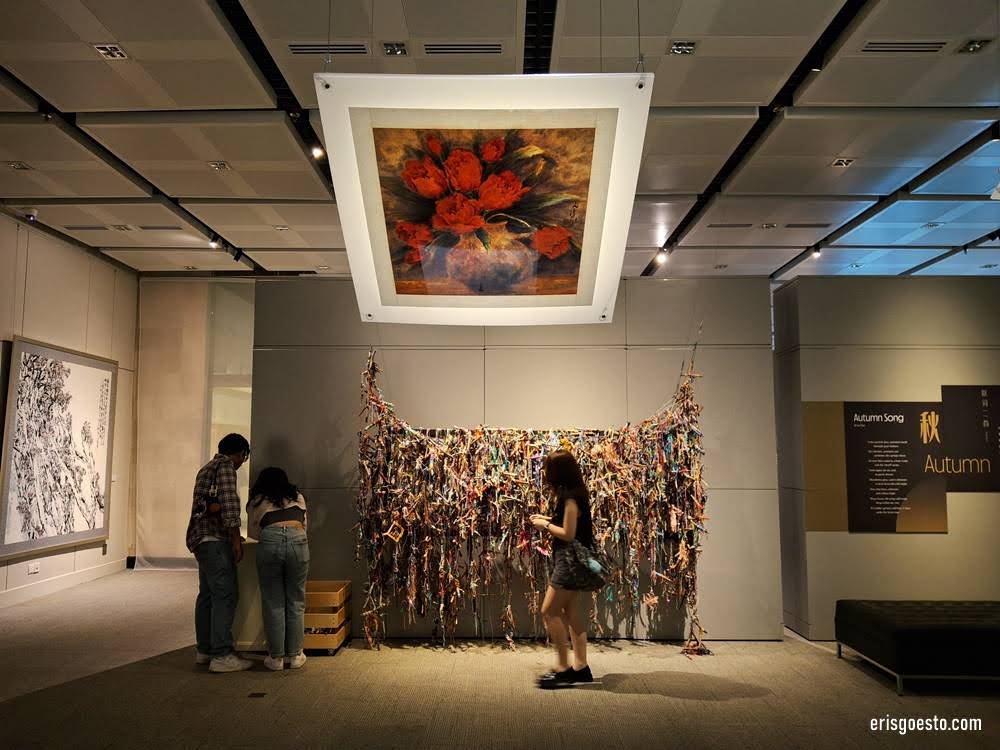
Kuala Lumpur is home to several prominent art galleries (Balai Seni Visual Negara, the Ilham Gallery), which are often mentioned in tourist itineraries. If you’re looking for something off the beaten path, however, check out Wisma Kebudayaan Soka Gakkai Malaysia (WKSGM), located just off Jalan Bukit Bintang.

If the name Soka Gakkai sounds familiar, that’s because it’s a prominent Buddhist grassroots movement centred around humanism. Founded in Japan following Nichiren Buddhism teachings, it currently has members in over 192 countries worldwide, including Malaysia. The Wisma in KL spans 12 storeys, and was opened in 2001 to promote peace through artistic, cultural, and educational exchanges and events.
The building is quite narrow and parking is limited, so I recommend taking the train to Bukit Bintang and walking from there, which takes about 10-15 minutes.

Not all floors are open to the public, but staff members are always happy to point you in the right direction. We started off on the top floor, which houses a mini museum dedicated to Soka Gakkai’s history and the work they do around the globe, much of which is centred around education, arts and culture, humanitarian relief, and community engagement.
Visitors will learn more about each of Soka Gakkai’s founding presidents, all of whom had difficult backstories, but still chose to work towards a greater good, which I find very inspiring.
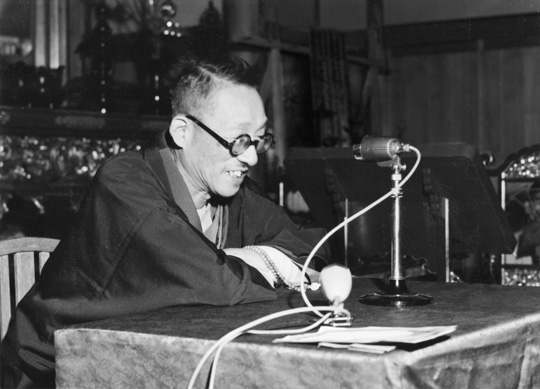
The founders, Tsunesaburo Makiguchi and Josei Toda (pictured above), both of whom were educators, were imprisoned for opposing militaristic government policies towards education, while its third president, Daisaku Ikeda witnessed the horrors of WWII as a teenager, which set him on a lifelong path to promoting world peace.
No photography is allowed on this floor, which is why I don’t have any pix to share – but definitely come and have a look to understand more about Soka Gakkai’s rich history before you venture to the other floors.

Aside from his humanitarian work, President Daisaku Ikeda was a talented artist as well. While he was never trained professionally, he often took pictures of scenery at the places his work took him to – a collection of which is showcased at the WKSGM.
His photos often captured scenes of nature, from snow-capped mountains to the vast breadth of the ocean, to the blossoming of flowers. N and I both agreed that they have a melancholic, almost haunting beauty to them . At least for me, I felt a sense of shared wonder – it was as if I could picture the breadth of the photographers feelings as he captured that particular shot.
Public photography is again, not allowed on this floor – but after exiting the exhibition you can sit in a cosy nook and browse through some of his photography collections in book form. You can also buy them online.

We next explored the Blossom of Hope – A Floral Art Exhibition, which showcased various media with flowers as the primary subject. Aside from oil and acrylic paintings, there were also spatial installations and ones that the public could interact with, adding their own spin to the overall artwork. The collection was diverse, with works from local as well as international artists in both traditional and contemporary formats.

The Country of Mugunghwa (Rose of Sharon), 2015, ink and colour on rice paper, by Chin Kwan Hwi.


Gintajali by Bengali poet Rabindranath Tagore, etched on a frosted glass window.

View of the city from the Wisma exhibition space.

Lotus, lacquer and nacre on wood by Zheng Yikun. Lacquer provides such a nice finish to things – in this piece, it made the leaves and flowers glitter in the light, giving the scene a multidimensional appearance.

The exhibition wasn’t exclusive to paintings, as there were art installations too. There was a large and colourful tapestry of threads and twigs, and visitors were invited to tie their own to add to the artwork.


Our final stop for the day was to Faizal Sidik: 25 years – Works from 1999 to 2024, a solo exhibition by Faizal Sidik. Spanning two floors, visitors were privy to the artist’s body of work and its evolution through the years, dabbling in various art styles and forms.


I enjoyed his newer works, which are inspired by the geometric patterns of the Malay songket as well as pixels, combining the traditional and the modern. Above is Suparupa Garden, acrylic on canvas (quadriptych / 4 panels) (2019-2021), a large piece measuring 20 ft x 7.5 ft, which formed the centrepiece of the showcase on the ground floor.
While the exhibitions above are no longer running (I left this post languishing too long in drafts, sorry!), WKSGM runs new exhibitions all the time, so do check out for the latest updates on their website.
Overall, I think Wisma Kebudayaan Soka Gakkai Malaysia is a great place to soak in arts and culture in the city, and it’s for a good cause as well – to understand how arts can be a powerful medium of education and to promote understanding and peace. Not many tourists / locals are even aware of the place, so give it some loving! Entrance is free.
WISMA KEBUDAYAAN SOKA GAKKAI MALAYSIA
No.243, Wisma Kebudayaan Sgm, Jln Bukit Bintang, Imbi, 55100 Kuala Lumpur
Opening hours: 11AM – 5PM (closed Mondays)
Phone: 03-2144 8686
PS: If you enjoyed reading this, please consider supporting my website via Patreon. This will go towards hosting fees and ensuring that I can continue to deliver authentic content for your reading pleasure. Or buy me a cup of coffee at paypal.com @erisgoesto. Thanks for stopping by!
PS2: All expenses are out of my own pocket unless otherwise stated. Views here are my own and are based on my personal experience. They are not meant to endorse or disparage businesses or institutions in any way.


Leave a Reply