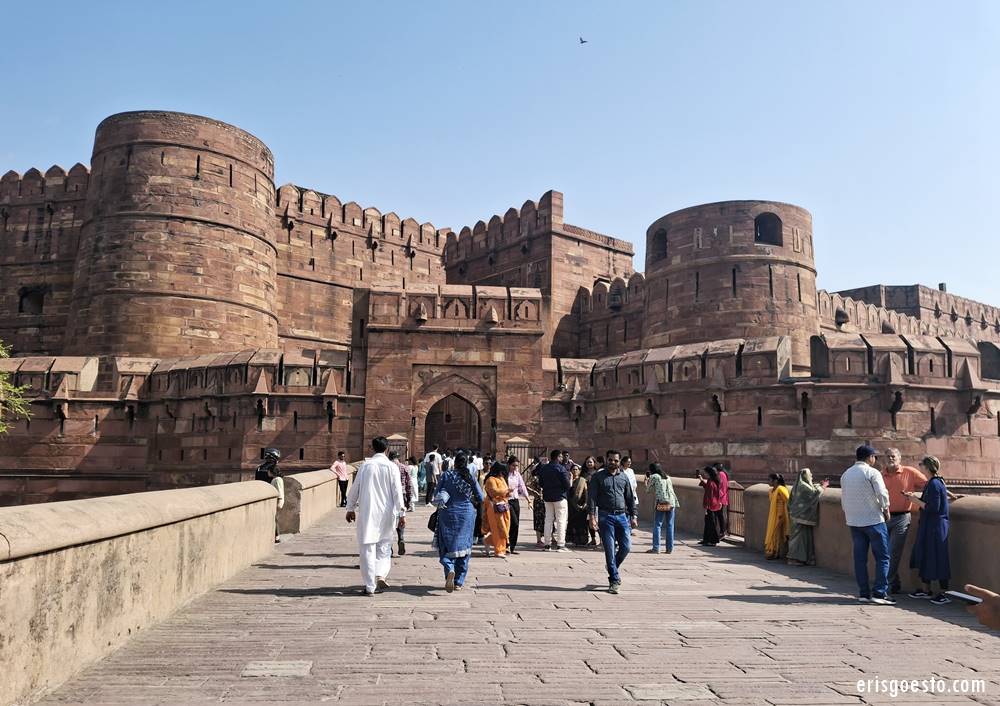
The ancient royals of India were incredibly rich and powerful, so it’s no surprise that they lived in glamourous abodes, privy to every sort of luxury and comfort imaginable.
A prime example of this is Agra Fort, a royal residence-cum-walled city in Agra, that acted as the seat of the mighty Mughal empire from the late 16th to the mid-17th centuries. At present, the fort is a UNESCO World Heritage Site, visited by millions each year.

Although the Mughals made the fort what it is today, they did not lay its foundations, as there was actually a preexisting fort in the area, occupied by the Rajputs (another dynasty). However, it was in ruins when third Mughal emperor Akbar (grandson of Babur, founder of the empire) arrived in Agra.
Deciding that the location was prime, he ordered a new fort to be built over the old one, with red sandstone forming the bulk of the exteriors (hence the nickname ‘Agra Red Fort’). Later on, Akbar’s own grandson Shah Jahan (yes, that Shah Jahan of Taj Mahal fame) upgraded it even further with buildings of white marble, reflecting the materials used in the Taj.
Walking in the footsteps of kings

There are four gates leading into the walled city, the grandest being the Delhi Gate on the west side. However, the Indian Army uses it (parts of the fort are still actively occupied by the military) so visitors instead go through the Lahore Gate on the south side, also called the Amar Singh gate. This was also the gate that Emperor Akbar and his entourage used to enter the fort, so you’re literally walking in the footsteps of kings!

Interesting tidbit: Amar Singh was a Rajput noble who was known for his bravery and might, rising in the ranks of the Mughal court thanks to these qualities. However, he was displeased with the emperor levying a fine on him for an unauthorised absence, and legend has it that he slayed Shah Jahan’s treasurer who came to collect the money.
What followed was a daring escape attempt as he leapt from the fort’s high walls on a horse (spoiler: the horse died, Amar did not). That was remedied quickly, though, as he was captured and put to death – but apparently Shah Jahan was so impressed by Amar’s bravery, he named the gate after him. Some form of consolation, I guess.

The fort grounds are huge, spanning some 94 acres, although only a small portion is open to the public. One of the first structures you’ll see upon entering the main courtyard is the Jahangiri Mahal, a palace built exclusively for the Hindu wives of Akbar’s harem, chief among them his favourite consort, Mariam-uz-Zamani, a princess of Amber.

More interesting trivia: Even though Akbar was Muslim, he never attempted to convert Mariam to his religion, and allowed her to practice her faith. Historians regard this as an example of the religious tolerance espoused during Akbar’s reign, as the monarch had a liberal belief for ancient times (and even in modern society) – that men were equal regardless of race or religion.

Right in front of the palace is a giant bowl carved from a single block of stone, used to hold rose water.


The Jahangiri Mahal features the same red sandstone construction as the fort’s walls. The exterior features more Islamic elements, but you’ll find Hindu influences within such as intricate carved pillars and reliefs of serpents, which are usually found in Gujarati temples.

Parts of the palace are faded with time, but you can just imagine how glorious it must have been in its heyday. These decorative nooks, for example, would have looked splendid a few centuries ago, the walls sparkling with semi-precious stones.


Adjacent to the Jahangiri Mahal is a pleasure garden for the ladies, dubbed Anguri Bagh or the Garden of Grapes. While it was in use, the garden was filled with all sorts of blooms and grapes, hence the name. There is an elevated marble platform with a sunken pool dominating one side of the courtyard. There were also hot and cold water hammams, with nooks that housed candles at night and flowers during the day. The tech was very advanced for its time : there were even water channels which were used to chill wines!

A Beautiful Prison
For all its beauty and grandeur, Agra Fort has its fair share of tragic history, the kind that comes from political intrigue and the power struggles of ruling a vast empire. The same palaces that Shah Jahan built for his pleasure and rule were in later years used as his place of imprisonment, most notably the Muthamman Burj.

This multi-storey marble tower, perched on the edge of the fort overlooking the mirror, was where Shah Jahan would govern from and it had the most gorgeous views of the Taj Mahal, so that the emperor may gaze upon the monument’s building progress. The walls are profusely covered in inlaid gemstones, done using the pietra dura technique.

Since the Mughals did not believe in primogeniture when it comes to ruling (ie the throne would go to the eldest son), it was all out war for Shah Jahan’s four sons when it came to the matter of succession. Shah Jahan favoured his eldest Dara Shikoh as heir, so the other three raised their own armies against him. This was not unusual – Shah Jahan himself executed his own brother to claim the throne.

The third son, Aurangzeb, ultimately emerged victorious. He backstabbed his allied younger brother Murad (after having promised to split the kingdom equally), defeated his second brother Shuja (who fled to Burma and was there executed by local rulers), and finally Dara Shikoh himself (particularly brutal because he had his brother’s severed head sent to him as proof of death).
While all this is happening, Aurangzeb also imprisoned his father in the Fort, where the old emperor was cared for by his favourite daughter, watching his empire being torn apart and gazing longingly at his wife’s monument in the distance. He finally passed away after eight long years. Ironically, Aurangzeb was his child from his most beloved queen, Mumtaz Mahal.
Welp. As they say, all is fair in love and war.

Agra Fort is a vast complex, so if you have the time, I recommend spending at least half a day here with a tour guide so that you can better understand the place’s rich history. Better yet, book a private tour so you don’t have to worry about transport, entry tickets, etc. and just truly enjoy the experience.
BUYING TICKETS
Tickets can be purchased onsite or online at https://asi.payumoney.com/quick/agf. Entry is priced at 50 rupees for locals, and 650 rupees (USD7) for foreigners.
PS: If you enjoyed reading this, please consider supporting my website via Patreon. This will go towards hosting fees and ensuring that I can continue to deliver authentic content for your reading pleasure. Or buy me a cup of coffee at paypal.com @erisgoesto. Thanks for stopping by!





Leave a Reply