The Reunion Dinner on the eve of the Lunar New Year is one of the most important occasions for Chinese families, where family members travel back to their respective hometowns and gather for a feast.
For many of us who work in cities, it is perhaps one of the rare times that we see all our relatives under one roof. Although in recent years, since my grandparents’ passing, it has become rather quiet. Some cousins drop by for short visits, while others prefer going overseas for holidays. This year was a very subdued affair, since the only people in the house were my elderly aunts.
Prayers and Preparations

Before the dinner, my aunt cooks dishes to be presented to the Gods and my ancestors at the altar. Then we ‘invite’ them to join the dinner later at night.
Traditionally, people use xing bui, or mooncups, to indicate if the invitation has been accepted. The cups are thrown onto the floor and one should face up and the other down, an affirmative sign. Otherwise, we keep trying until we get the desired result. I think it defeats the purpose because stastically the cups are bound to turn up that way at some point even if you don’t get it on the first try
In my family, we use coins instead of cups. The coins have been handed down for generations and are really old. One dates all the way back to 1896!

The practice of burning paper notes is typically done during Qing Ming or the Hungry Ghost Festival, but we observe this during the Chinese New Year as well. Since the New Year for the Chinese is strongly tied to wealth and prosperity, the idea extends to our dead relatives as well, as a way to pay respects.
Reunion Dinner Dishes
Now we come to my favourite part of the celebrations: food. The Han Chinese subgroups, such as Hokkien, Hakka, Cantonese, Teochew, and Fuchow, each have their own specialty dishes. While my dad is Hokkien, his hometown of Ipoh is strongly Cantonese, and as such the dishes at our CNY table share influences from both subgroups.

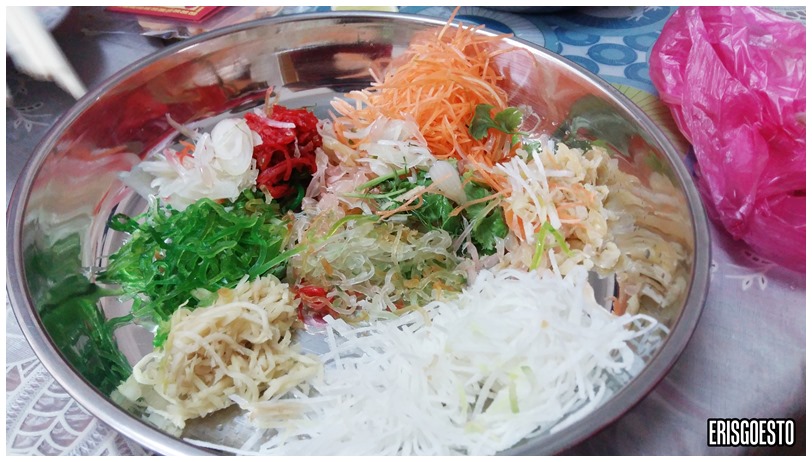
A must-have dish during Chinese New Year across most Malaysian Chinese families is yee sang, a salad-like mix of shredded vegetables, pomelo, onions, condiments and crunchy snacks, tied with plum or fish sauce. The tradition is to toss the yee sang while saying well wishes out loud, to bring joy and luck into the new year. There isn’t a hard and fast rule to the ingredients used in yee sang – in modern times, fruit yee sang has become quite popular.
**Despite its ubiquity, yee sang isn’t actually that traditional, as it was believed to have been invented in the 1940s by a Cantonese immigrant from Seremban.

Life was often difficult in the olden days, and meat like chicken was reserved for special occasions like Chinese New Year. So even though we get to enjoy it regularly now, poached chicken is still considered celebration food. The version done by my aunts is perfectly executed: tender and juicy, the chicken’s natural flavours shone when dipped into soy sauce.

Roast pork belly is also a popular celebration food – for larger families, they may even order a whole roasted pig. The crisp and crunchy skin perfectly contrasts with the softness of the meat.

Shrimp is good to have in the new year, since ‘ha’ sounds like a homonym for laughter. For this celebration, my aunts cooked them in curry leaves for a fragrant aroma and rich taste.

The use of curry leaves is a Malay / Indian influence: since our family once lived next door to a Peranakan family, my grandmother learned how to make Nyonya dishes. Her curry chicken was a family favourite – unfortunately, we haven’t been able to recreate the exact same taste since she passed away.
Another dish that hasn’t graced the table for awhile is jiu hu char, a beloved Nyonya dish of shredded jicama, carrots, and mushrooms stir fried with dried cuttlefish (only because it is very labourious to make, and my aunts are getting older).

Not everything is about tradition, as we live in modern times. It was my dad and my second uncle’s birthday, so we got them a carrot cake !
These cultural practices and celebratory foods that I’ve shared are but a fraction of the many traditions that the Chinese practice (we are generally a superstitious lot, after all). Some of them didn’t make much sense to me when I was younger (eg I always wondered why we couldn’t just get KFC for reunion dinner lol). As I grow older, I’m starting to see the value and beauty behind some of these traditions. Food, in particular, carries memory – even though my grandparents are gone, I can appreciate the care and thought that my grandma put into her dishes, wanting to put together an auspicious feast on the rare occasion that the entire family comes together to enjoy a meal.


Leave a Reply