India often gets a bad rap in mass media. It’s either portrayed as this loud, chaotic place riddled with poverty-stricken neighbourhoods and scam centres, or fetishised as an exotic land of mustachioed maharajahs, mystics, and yogis.
While all these things may exist, the truth, however, is that it’s impossible to distill a nation so incredibly vast and diverse into a single narrative.
Take Delhi, for example. As the capital of India, it is home to a whopping 30+ million people and one of the most densely populated regions in the country. Parts of it are indeed as shown on TV – the chaotic traffic, the honking rickshaws and sea of humans crowding the streets, the tightly packed buildings and insane tangle of electrical wires.
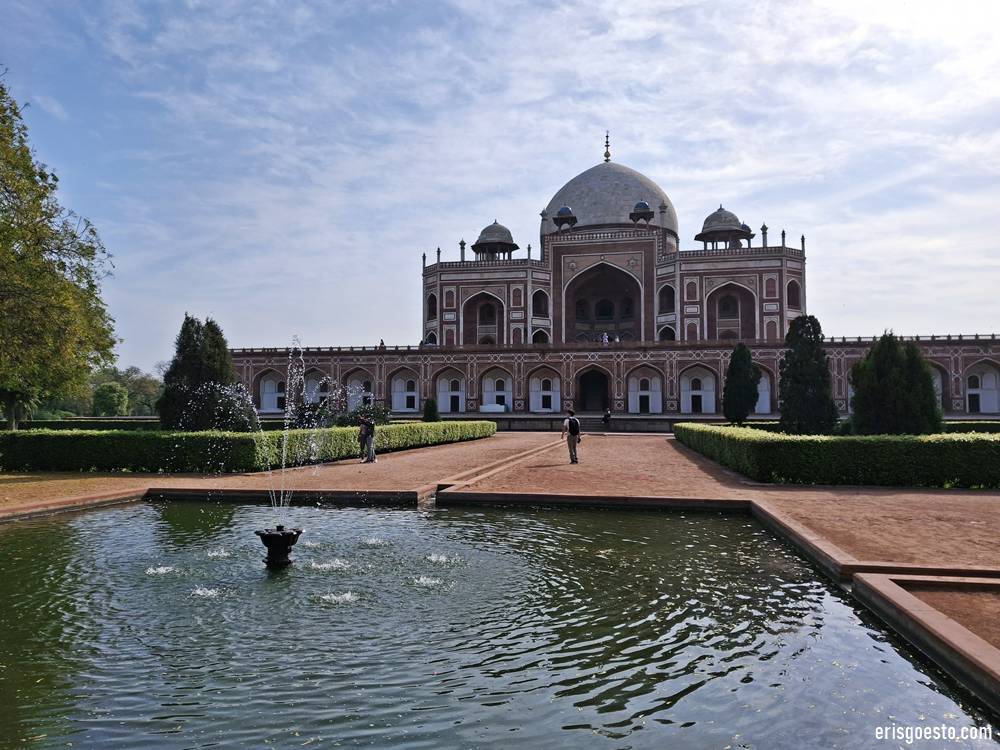
But there are pockets of beauty and tranquility too – such as Humayun’s Tomb, a UNESCO World Heritage Site and the first place I visited in the capital.

Delhi has ancient roots, but it was really the Mughal empire – which ruled from the city for over three centuries – that shaped much of what we see today in its culture and architecture. One such legacy is Humayun’s Tomb, which houses the remains of the second Mughal Emperor, Humayun. Built in the 16th century, it is the first garden-tomb in the subcontinent and later acted as a blueprint for the Taj Mahal.

Entry to the grounds cost 600 rupees (about RM28 or USD7) for foreign visitors, which is tenfold what locals pay (40 rupees). But considering how historically significant the place is and how well the place is kept, I think it’s well worth the price. It’s also a great for some peace and quiet if you want to escape the noise of downtown Delhi.

One of the primary features of Humayun’s Tomb is its massive Charbagh, a quadrilateral garden featuring four gardens separated by waterways, symbolising the four gardens and four rivers of Paradise as mentioned in the Quran. Spanning 30 acres, the design was originally Persian, and since the Mughals were from Central Asia, they were the first to bring this style over to India. The most famous charbagh, is, of course, the one at the Taj Mahal.

The gardens and the tomb look stunning today, but a tonne of painstaking work has gone into its restoration over the years. There was a point in time when they were badly damaged due to neglect and conflict, and it was even used to house refugee camps during the 1947 Partition of India. It was not until the 2000s, when UNESCO declared it a World Heritage Site, that much of it was restored to a fraction of its former glory.


Entry to the inner walled enclosure is via the South Gate, itself an impressive structure made from materials matching the main tomb. I was surprised to see what looked like two Star of Davids above the archway, but our guide clarified that these hexagram patterns are also common in Islamic art, since Judaism and Islam have similar roots. In Islam, the symbol is known as the Seal of Solomon, a revered figure in both Jewish and Islamic tradition.

Passing through the gate, visitors are greeted by the sight of the grand mausoleum, its gigantic dome towering imposingly over the landscape. The white of the marble dome contrasts splendidly with the rest of the building, which is made of red sandstone, a common material in many Mughal buildings due to its hardy qualities, easy availability, and regal hue. The structure’s appearance is further beautified with yellow sandstone and black marble borders.


A closer look at the tomb’s exterior, where there are more Seal of Solomon symbols sitting atop arched recesses. While they don’t seem to serve a particular purpose, the nooks add more depth and complexity to the facade.


The sides of the tomb where smaller windows are located are covered in intricate jaalis, or stone latticework.

The mausoleum’s central chamber forms an octagonal shape, with a simple marble cenotaph in the centre. The emperor’s actual remains are located underground, directly underneath it, but the chamber is not opened to the public.
Aside from the Emperor, the tomb houses various other Mughal royals and nobles, including that of his consort the Empress Bega Begum, who was the one who commissioned the tomb nine years after Humayun’s passing, as well as Dara Shikoh, the eldest son of the great emperor Shah Jahan.

While the interiors look bare today, an English merchant visiting in 1611 once described the chamber as being richly furnished with carpets, with copies of the Quran placed above the cenotaph alongside Humayun’s sword, turban, and shoes. It must have been quite the awe-inducing sight!

Before leaving, we stopped for a quick photo of Isa Khan Niyazi’s tomb, which sits within its own enclosure just before the West Entrance. The tomb actually predates Humayun’s by two decades – and surprisingly – houses the remains of Isa Khan, an Afghan noble of a rival dynasty that temporarily overthrew the Mughals (they ruled for about 15 years), which resulted in Humayun being exiled for a period of time. But I guess it goes to show that there is respect among the nobles, since the tomb was left untouched even after the construction of Humayun’s Tomb.
The style is significantly different, although the building’s material is similarly made of red sandstone. The dome is black, with blue glazed tiles adorning the smaller domes that surround it, which gives the tomb a more colourful appearance.
Humayun’s Tomb Complex is a must visit while in Delhi – not just for the wonderful architecture but also its sheer history. Strolling through its vast gardens, its easy to picture how glorious it must have looked at its peak – a symbol of the power and influence the once mighty Mughal empire wielded in the region.
HUMAYUN’S TOMB
Hazrat Nizamuddin Aulia Dargah, Mathura Rd, Nizamuddin, Nizamuddin East, New Delhi, Delhi 110013
Opening hours: Sunrise to 7.30pm (daily)
Getting There: I went on a tour bus – but for those commuting, the closest Metro station according to Delhi Tourism is the Jangpura (Violet Line), about 1.5km from the tomb. From the station, travelers can take a five minute rickshaw or cab ride.
***
PS: If you enjoyed reading this, please consider supporting my website via Patreon. This will go towards hosting fees and ensuring that I can continue to deliver authentic content for your reading pleasure. Or buy me a cup of coffee at paypal.com @erisgoesto. Thanks for stopping by!




Leave a Reply