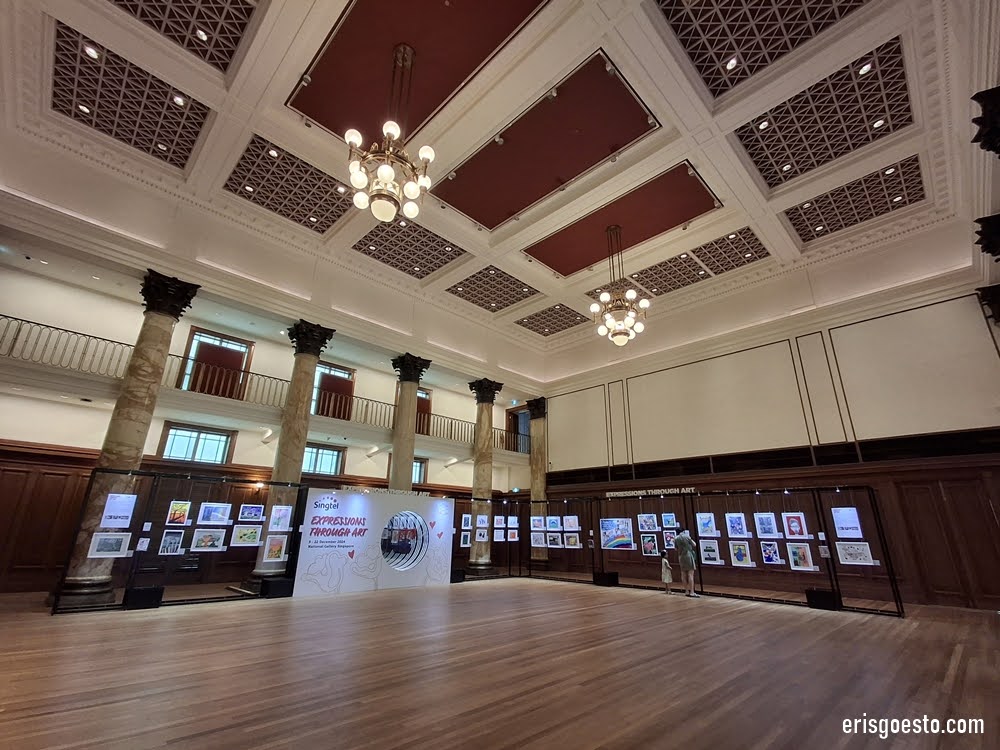
One of my biggest regrets from my recent Singapore trip was not allocating enough time to fully explore the National Gallery Singapore. Our commute from JB to Singapore took longer than expected and we also stopped for lunch, so it was nearly 1pm by the time we got to NGS, leaving me with just 2.5 hours before I had to rush off for a meeting. Still, I thoroughly enjoyed my time here, and hope to return someday (this time, with proper planning)!

Housed within the former Supreme Court and City Hall, the National Gallery Singapore contains over 9,000 modern artworks from all over Southeast Asia. The buildings themselves are architectural marvels, beautifully restored and retaining many of their original design elements – such as the timber-paneled courtrooms and the imposing marble-floored foyer of the Supreme Court, with its sweeping balustrade staircase.
Singaporeans enjoy free entry, while foreigners have to purchase a $20 (RM65) ticket. There were a few special exhibitions running too, which we paid an additional $10 for.

We began our exploration at the City Hall Wing, which comprises five floors. Level 2 houses the DBS Singapore Gallery, which runs the Singapore Stories: Pathways and Detours in Art. Most of the pieces here are by local artists from as early as the 19th century, depicting the story of Singapore through art, how it has evolved through its relatively short but storied history, and its place in contemporary Singaporean society.

Malaysia and Singapore share a lot of common history, so many of these pieces felt familiar – such as these reproductions of Malay instructional booklets from the 1950s, when Singapore was for a brief period part of the Federated States of Malaya. Many of the pieces, especially the posters and paintings, had a colourful, handpainted quality ubiquitous to artworks of the era, which evoked a sense of nostalgia.

As mentioned, there were two special exhibitions running during our visit. One of them was Teo Eng Seng: We’re Happy, Are You Happy? in which the veteran artist – who is in his 80s and has spent over seven decades creating thought-provoking art – presented a collection of his life’s works, about 70 in all. The exhibition space itself was striking, with the walls and floors decked out blood red and black hues that made each art piece pop.

Known for creating the paperdyesculp medium (made of papier mache mixed with fabrics, fibreglass, or other materials), Teo’s pieces are typically a riot of colours, shapes, and textures, and include everything from paintings to sculptures. Admittedly, I found many of them too abstract (such as one piece called NetanyaWhoo! which Teo describes as a response to the the Israeli Prime Minister’s chaotic first term, but in which I could not identify what the sculpture actually was). I guess this is what they mean by art can be anything, since it asks viewers a question and lets them interpret the piece according to how they see it.

The other special exhibition located on the same floor was Kim Lim: The Space Between, A Retrospective. The late artist, who died at the relatively young age of 61, was known for her abstract wooden and stone sculptures that explore the relationship between art and nature. Despite their minimalist appearance, the works are anything but simple – if anything, you can see that each piece has been meticulously shaped and crafted to just the right form, curve, or line that the artist intended to achieve. Sometimes, different shapes would come together as a whole, stacked together atop each other in carefully balanced symmetry.


Aside from stone and wood, Lim worked with other media too such as paper.

While here, don’t forget to visit the City Hall Chamber, an opulent space that has borne witness to many of the nation’s historic moments. It was here that Japanese forces signed their document of surrender in 1945, bringing an end to the turmoil of WWII in the region, and it was also here that Singapore’s first cabinet was sworn in. Today, much of the space’s original design – most notably the Siena marble columns and their bronze capitals, the elegant teak wood panelling, and the grand chandeliers – have been preserved.

Time to make our way to the next building! The City Hall Wing and the Supreme Court Wing are connected by bridges across two levels. As you traverse them, you’ll be able to see the ‘exterior’ details of both buildings –the former’s neoclassical columns topped by ornate carvings, the latter’s more austere-looking windows. Above this atrium space is a filigreed roof made of glass and steel, held up by giant branching struts. The roof features a lattice-like pattern, resembling a traditional rattan weaving to allow natural sunlight to illuminate the spaces below.

I was running short of time at this point – so I left N behind to wander around at his leisure, while I tried to breeze through the rest of the exhibits (unfortunately I missed a lot). An exhibition called Between Declarations and Dreams: Art of Southeast Asia Since the 19th Century runs through Levels 3 – 5, and features a wide collection of Southeast Asian art and history.

The original courtrooms have also been kept intact, including fixtures such as the prisoners dock, judge’s seat, bookcases, balconies, and the carved wooden ceiling.
The walls are bathed in a velvet red and decorated with oil paintings on the mezzanine floor. You can also join the Back-of-House Guided Tour: “Former Supreme Court: Unseen, Unheard”, which takes visitors on a behind-the-scenes tour of the supreme court, including jail cells and passageways that led prisoners to the courtroom for trial.

View of the judge’s seat from the dock.

The Supreme Court Wing’s hallways are bathed in a dim light, giving the space an almost sepia-like quality. One of the key rooms here is the Rotunda Library & Archive — unfortunately it was closed during our visit.

The multiple galleries here play host to a vast collection of Southeast Asian art. One particular gallery exhibits works by famous Filipino artists, such as Juan Luna and Fernando Zobel. Some of Luna’s most iconic pieces, such as the “Spain and the Philippines” series can be found here.

La Banca (the Native Boat) by 19th century Filipino painter Felix Resurrecion Hidalgo, a contemporary of Juan Luna.

Portrait of revolutionary Jose Rizal by Fabian de la Rosa. Many of the works by these artists reflected the Spanish influence in the Philippines, as the styles clearly draw inspiration from the oil paintings of 19th and 20th century Europe, with realistic depictions in muted colours.


Galleries housing more modern works of artists from around the region.

Besides its impressive collection of artwork, the Supreme Court Wing itself is a work of art and design. The Historical Lobby, which is close to the Padang entrance of the building, has been painstakingly restored by taking apart its floor and ceiling before reinstalling each component.
Like the City Hall Chamber, the ceiling here is wood panelled. In contrast to the building’s neoclassical exterior, the interiors feature Art Deco fixtures and elements. I especially like the marbled black and white tiles on the floor, which are polished to a shine. Not hard to imagine the atmosphere back in the day, with the click clacking of shiny leather loafers on the very same floor as lawyers and judges in suits made their way to the courtrooms.

The eight sided foundation stone has been left intact at the foot of the stairs. Inside is a time capsule which is set to be open in the year 3000.


I would have liked to spend more time at the Gallery, unfortunately the visit had to be cut short due to my appointment, which was a shame as I felt like I had not gotten my $30 ticket’s worth (yet!). Definitely looking to make a return on my next visit to Singapore.
NATIONAL GALLERY SINGAPORE
1 St Andrew’s Road, Singapore 178957
Opening hours: 10AM – 7PM (daily)
Getting There: The closest MRT is City Hall (7 minute walk). You can also alight at Clarke Quay (10 minute walk) or Raffles Place (10 minute walk).
https://www.nationalgallery.sg/sg/en.html
PS: If you enjoyed reading this, please consider supporting my website via Patreon. This will go towards hosting fees and ensuring that I can continue to deliver authentic content for your reading pleasure. Or buy me a cup of coffee at paypal.com @erisgoesto. Thanks for stopping by!
PS2: All expenses are out of my own pocket unless otherwise stated. Views here are my own and are based on my personal experience. They are not meant to endorse or disparage businesses in any way.


Leave a Reply