Spanning some 45 hectares on the fringes of Kuala Lumpur, Zoo Negara is Malaysia’s first zoo, having opened its doors in 1963. It houses over 5,000 animals from more than 460 species. Known as the ‘zoo in the jungle’, many of the animal enclosures and visitor pathways have been built around the area’s natural landscapes and are surrounded by lush vegetation.


This is not my first rodeo at the zoo, but my last visit was in 2014. Obviously, I couldn’t remember where to turn in and ended up at Pintu B, which is at the backside of the zoo. It’s a further walk to the main enclosures, and you miss taking photos of the grand entrance, but it’s less crowded and easier to find a parking spot.

Pintu B is close to the Tunku Abdul Rahman Aquarium. Named after Malaysia’s first Prime Minister, this is one of the oldest public aquariums in the country. The interior is air-conditioned, with hallways taking you through sections dedicated to different aquatic environments, like the Upper Stream Zone, Mid Stream Zone, Wetlands Zone, Low River Zone, and Mangrove Zone. Swimming in the tanks are species such as toman (giant snakehead), catfish, and blue mahseer. It’s a rather small space, so you will be in and out in less than half an hour.


After the aquarium is the penguin enclosure, which houses a number of Humboldt penguins. Measuring around 50 to 75 cm in height, these aquatic birds are native to the coasts of Chile in South America. They look very similar to the Magellanic penguin, with a black band running across the chest. In fact, they are sometimes documented living in mixed species colonies with their Magellanic cousins.

There was an elevated wooden bridge to cross which spanned two enclosures, with hippos on one side and alligators on the other. They were partially submerged in the water, so this was the best shot I got.
PS: I was so focused on the hippos that I totally missed the fat monitor lizard nearby sunning itself on the rock. Don’t think it’s part of the enclosure, but just came visiting from the nearby jungle.

The gaur are a type of wild cattle native to India and Southeast Asia, known for their large size and bulk. Sadly the species is in decline in the wild, with some regionally extinct in places such as Sri Lanka and Bangladesh.

If you’re visiting the capybara enclosure, keep your eyes peeled for an impostor amongst the furry rodents. Yes, that’s an orange cat curled up on the right. We hung around waiting for it to turn around but it just kept showing us its butt.
Oyen, as the cat is known (or as all orange cats are known in Malaysia) was ‘adopted’ by the herd and has been living with them for several years. In fact, a few months after our visit, the clip of Oyen hanging around the capybaras went viral online, even being featured on the BBC – and visitors flocked to the zoo to see him specifically.
Not the exotic giraffe. Not the majestic elephant. The Oyen.
On August 8, he even got his own name on the enclosure – so it’s now known as Oyen & the Capybaras! (Sounds like a great name for a band).

Oyen and his capybaras aren’t the only interspecies bunkmates you’ll find at Zoo Negara. The Malayan tapir shares his space with a couple of deers too.
Whenever we mention animals in Malaysia, people tend to think of the Malayan tiger and the orang utan, but I think the tapir deserves a lot more loving. Its black and white coloration is very unique, for one – sort of like our version of a panda. It’s also the only one of its family found outside the Americas. Fun fact: despite looking more like a pig because of its short trunk, tapirs are actually more closely related to horses and rhinos!

The Australian plains area houses a couple of wallabies, which are a member of the kangaroo family.


We were pressed for time since we arrived at the zoo quite late, so we skipped a couple of exhibits and made a beeline for the lake, where visitors will find flocks of flamingos.
There are no cages to keep them in, so they just fly in and out whenever they want and return to roost. Sometimes, if you’re driving on the MRR2 highway, which is adjacent to the zoo, you might see flamingoes perching on the street lights.

After a long walk, we finally made it to the savannah, which has some of the bigger animals, such as the rhinos and giraffes. There’s an elevated platform that you can walk up to get closer but most of the animals stayed away from the area.

The giraffes were housed together with ostriches and a solitary zebra. The last time I was in Zoo Negara, there were two giraffes – not sure if these are the same, but I noted the presence of a calf. It stayed close to its parents, occasionally nuzzling up to its mother’s legs and rubbing its neck affectionately on her hind quarters.

There is an Ape Centre housing chimpanzees and orang utans. We didn’t see the chimps, but met two of the latter. One was munching on a coconut while lounging on the edge of the platform – a pose that was extremely intelligent and humanlike.
In fact, we witnessed the one on the right tossing some coconut to two gawking visitors nearby, who were waving and trying to get its attention. Yes I used the word toss, because it wasn’t throwing the fruit to get rid of them. It deliberately used a scooping motion – the way you would throw a ball into a basket at a carnival – as if it was feeding the humans. Like “Yeah yeah, here’s some coconut. Now can you stop acting like a monkey?”
Who’s gawking at who now? Perhaps we look like the animals in cages to them.

The nearby Asian elephant enclosure. Among the large animal enclosures, I think this was the one that could do with improvement. It was bare, not very spacious, and there wasn’t a lot of natural shade. The animals looked bored too.

I’ve saved the best for last.
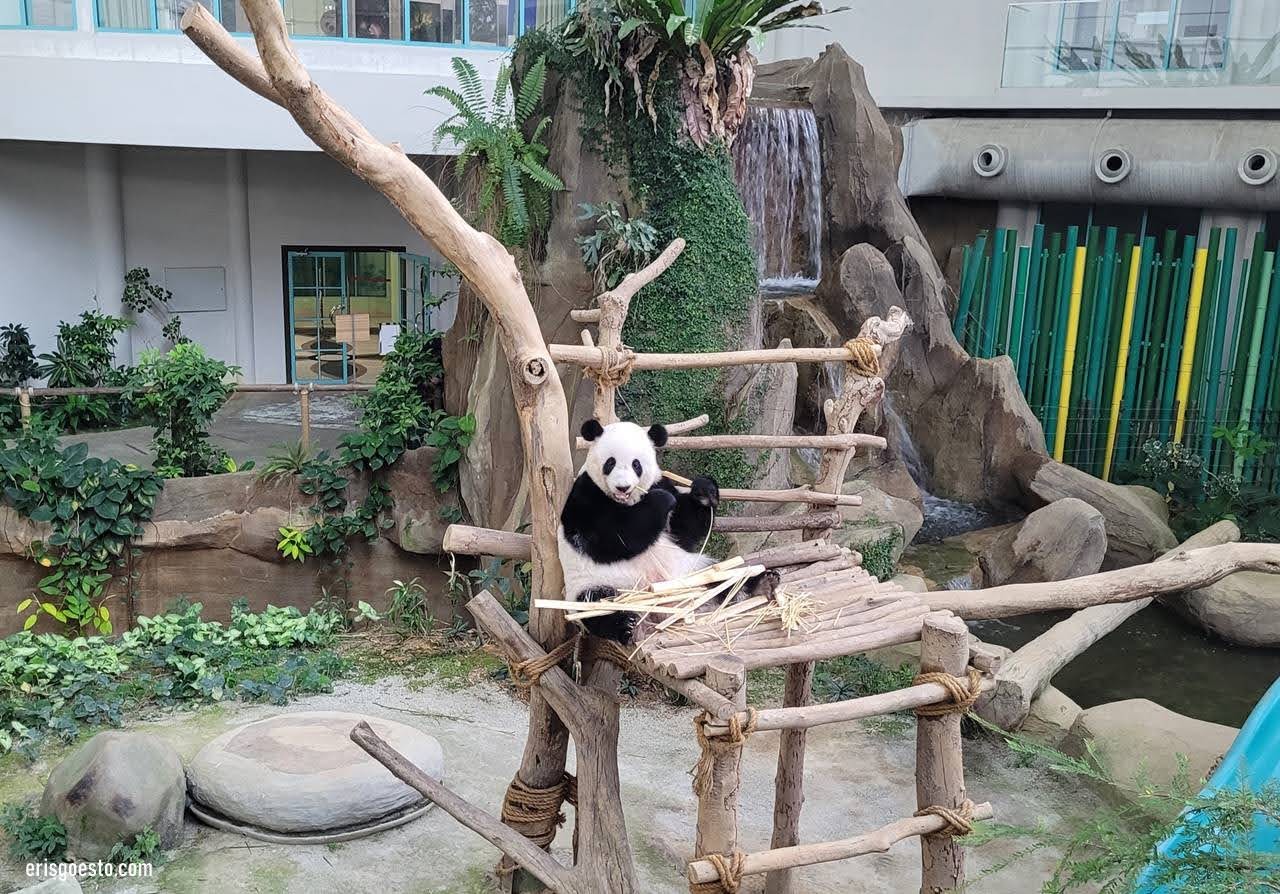
Zoo Negara’s panda conservation centre is its star attraction (aside from Oyen, of course), and was purpose built to house two giant pandas, Xing Xing and Liang Liang. The pandas were born in China in 2006, and in 2014, loaned to Malaysia’s National Zoo as a sign of friendship between the two nations. During their tenure, the panda pair even conceived several cubs – one of which was sent back to China in 2017. The other two cubs, which are now fully grown, will also be departing on August 29.

In comparison to the rest of the zoo, the conservation centre feels much better maintained. The interior is air conditioned to keep temperatures optimal for the pandas, and their enclosures are spacious and nicely landscaped, with clean water, as well as plenty of toys and structures for them to clamber over and play on. Visitors are only allowed a maximum of 15 minutes in the viewing area, so as not to crowd the place and stress the pandas.

I’ve read a lot of reviews of how the pandas sleep most of the time, but we were lucky as during our visit, they were both happily munching away on bamboo. Bamboo has little nutritional value, but for some reason pandas have evolved to subsist almost entirely on them, and so they must eat up to 84 pounds a day.

Why are pandas so irresistibly cute to humans? There’s something about their roly-poly body and black face patches, which give them the appearance of large eyes, as well as their propensity to sit upright like a human – that is decidedly baby-looking, a term dubbed in science as neoteny.
As humans, we are hardwired to like and think of such features as cute/adorable. Hence, the panda obsession. It’s become so much of a cultural icon that it’s almost a prestige dispensed by China, to loan pandas as a sign of goodwill and friendship (such as in this case, as the pandas were loaned to mark our 40th anniversary of bilateral relations with China).
Despite their cuddly appearance and seemingly bumbling demeanour, pandas can be unexpectedly ferocious. While attacks are rare, they can be deadly when they happen. Pandas are bears, and have the same massive power in their teeth and claws. There have been cases of attacks that involved close-to-severed limbs, as well as terrible bites.

What else do the pandas eat here aside from bamboo? You can watch staff preparing panda cakes in the kitchen, complete with full recipe on display.
***
While I enjoyed my trip to Zoo Negara, and appreciate that they’re doing their best as a non governmental organization that relies on public funds and entrance fees to maintain the place, I think there are definitely areas of improvement. In comparison to my visit in 2014, I felt like things are a step down from what they were before.
Some enclosures feel old and unkempt, with rusty fences. Signboards haven’t been updated in ages and look weathered, the writing barely legible. We also passed by this ‘Bee Museum’ which looked abandoned; the roof was rotting and pieces of wood littered the space, with puddles of stagnant water pooled around the structure. The exhibits were covered in dust, and it was just an eyesore. I don’t understand why they couldn’t just take down the structure or at least clean out the place, instead of letting it fester like that.
As for animals, most looked healthy, and they try to make the enclosures as close as possible to their natural habitats. But there were some that were clearly distressed. The bear, for example (not pictured here) paced repeatedly around its enclosure while panting – a pattern I believe is associated with extreme stress.

Facilities wise, there are trams to help people get around, especially older folks and children, so that’s a plus. But food options are limited, and the few that are open only carry snacks like waffles or chicken nuggets, which is not feasible if you’re there the whole day.
Overall, I still think visiting the Zoo trumps shopping at a cookie-cutter mall any day. There’s just a lot of unrealised potential here. I see how well they can do with the panda enclosure – it’s world-class. If the rest of the zoo could be just as well maintained, Zoo Negara could really return to its heyday as a premier tourist attraction in Kuala Lumpur, as well as an important centre to educate the public on wildlife conservation.
Entrance is RM45 for adult Malaysians, and RM18 for children. Foreigners, pay double, at RM88 per adult and RM43 for children. Online tickets are cheaper, so you can purchase them in advance here.
The Zoo is open daily from 9AM to 5PM, with last entry at 4PM.
Getting There
The nearest way by train (LRT) is to alight at Wangsa Maju Station on the Kelana Jaya Line, although you will still need to board a taxi to the zoo, which takes about 10 minutes. Rapid KL bus no. 220 from Lebuh Ampang, KL services the Zoo negara route.
Address: Jalan Taman Zooview, Taman Zooview, 68000 Ampang, Selangor
PS: If you enjoyed reading this, please consider supporting my website via Patreon. This post also contains affiliate links of which I earn a tiny commission from, which will go towards hosting fees and ensuring that I can continue to deliver authentic content for your reading pleasure. You can also buy me a cup of coffee at paypal.com @erisgoesto. Thanks for stopping by!
PS2: All views here are my own and are based on my personal experience. They are not meant to endorse or disparage businesses or establishments in any way.




Leave a Reply