Sprawled across 105 hectares next to the Marina Reservoir, Gardens by the Bay doubles as both an important green lung for Singapore as well as one of the city-state’s most popular tourist destinations, having welcomed over 50 million visitors since opening in 2012. Parts of the park – most notably the Supertree Grove – were also used as a filming location for the massive box office hit Crazy Rich Asians, further cementing the park’s reputation as an icon of Singapore.

My last visit here was a very short one, so this time around I was determined to enjoy a fuller experience – which meant forking out $59 (about RM200) for entry into the park’s two conservatories: Flower Dome and Cloud Forest. Both conservatories are a 15-20min walk from the Bayfront MRT entrance. You can take a buggy for $3, but I recommend going on foot since there are plenty of things to see along the way.

One of the better vantage points within the park is at Dragonfly Bridge, which spans a small body of water. From here, you’ll be able to see the Singapore Flyer to your left, and looking back, the Marina Bay Sands.


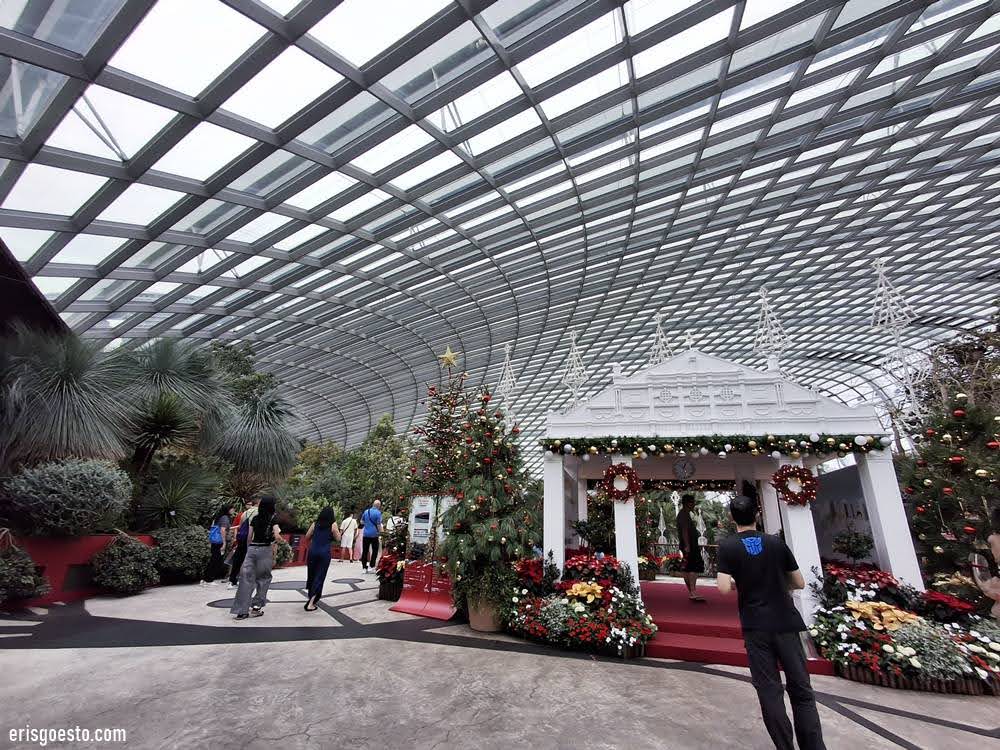
Arriving at the Flower Dome, I couldn’t help but gasp in awe at the sight of the thousands of glass panels supported by steel struts, criss-crossing overhead like a lattice. At 1.2 hectares, the structure is the largest glass greenhouse in the world and has volume equivalent to 75 Olympic-sized swimming pools. What’s even more amazing is that it was built without additional supporting columns in the middle, which lends to the feeling of vastness.

Inside the dome, temperatures are kept between 23 to 25 degrees Celcius to replicate a cool-dry Mediterranean climate. Since we visited close to Christmas holidays, there were plenty of decorations and coniferous plants decked out in festive baubles.


The area within the dome is split into several sections, each featuring plants from a certain region. From the entrance, take a left to the Australian Garden, where you can see endemic plants that have adapted to Australia’s bushfires, such as the grass tree – so called because its leaves look like blades of grass – as well as the Manuka Myrtle, the pollen of which is collected by honey bees and becomes Manuka honey.

The gardens are peppered with sculptures, some organic like these antelopes shaped from trunks; others from metal and other materials like ‘La Famille de voyageurs’ (A travelling family) by French sculptor Bruno Catalano. This eye catching installation showcases a family visiting the Gardens by the Bay, suitcases in hand, but instead of a full-bodied sculpture, they are deliberately hollow in places, giving them the appearance of floating in the air.


Finally got to see an actual olive tree at the Mediterranean Garden. I’ve only seen them in films and TV, and was not expecting them to be this large. There are 11 trees in the dome, and they range from 500 to almost a thousand years old!


Also in this section is a grove of Date Palms, which are grown as ornamental trees along the Mediterranean coast of Europe.

Did you know? Studies have shown that flowers are a natural mood moderator – perhaps because we all like looking at beautiful things, and flowers are definitely the crowning jewels of nature.


Making our way to the Flower Field on the lower level, our senses were in for a treat as we were surrounded by a plethora of bodacious blooms, each lovelier than the last. The themed Christmas decorations added to the festive cheer, including life-sized moose, a bright orange train carriage, and miniature trains loaded with ‘presents’, weaving their way through tracks lined with foliage, past replicas of historic landmarks like Grand Central Station.


Life-sized moose and cute Santas in a winter wonderland of poinsettas and pine trees, decked in shiny baubles.

Moving to the upper levels, we came to the Succulents Garden and the Baobabs (Bottle Tree). Upon entering this section, visitors are greeted by a towering figure of a girl in a polka dot dress called Kei-Chan – the work of Japanese artist Yayoi Kusuma.

The succulents were a change from the flowers at the lower levels, but they were no less intriguing, what with their varied forms, shapes, and sizes.

Some bulbous specimens

Next to the Succulent Garden are the Baobab Trees, characterised by their fat trunks and compact crowns. They are also aptly called the ‘tree of life’, as they provide shelter and food to various life forms in their native regions, namely parts of Africa, Australia, and Madagascar. The trees are among the most long-lived plants in the world, with some being carbon dated to over 3,000 years old. Literal living, breathing history!

Before leaving the Flower Dome, as part of our ticket, we also got complimentary access to Impressions of Monet: The Experience, which celebrates the life and times of Claude Monet, as well as the works of French impressionists like Auguste Renoir, Paul Cezanne, and Eduoard Manet.
Monet is, of course, an important figure in Impressionism, the art movement coined from one of his art pieces called Impression, soleil levant (Impression, Sunrise). During the early 19th century, Impressionist artists were considered rebels, breaking long-standing traditions in art. While traditional forms of art were often painted in studios and consisted of still life or portraits, Impressionists took their work outdoors, attempting to capture scenes and landscapes in the moment, as they happened. Movement was often a key element in impressionist paintings, as was the interplay of light in the paintings, depicting how actual sunlight would illuminate a scene naturally.

Works by Pierre-August Renoir, another major figure in Impressionism.

Replica of The Water Lily Pond by Claude Monet.
As you move through the exhibition space, it transitions from a classic ‘gallery’ into a digital tapestry, so you feel as if you are ‘stepping’ into an impressionist painting. Colourful screens depicting masterworks shift in tune to the hundreds of coloured lights hanging above, creating an ethereal scene.


And that wraps up our Flower Dome experience at Gardens by the Bay, Singapore! The steep price tag (blame it on the weak Malaysian currency) was definitely worth it, as we got to surround ourselves with beautiful blooms and see exotic plants that we would never have gotten close to otherwise. Since we came on a weekday, it was not too crowded, so we were able to really enjoy the entire experience without having to jostle through crowds.
Stay tuned for Part 2: Cloud Forest!
GETTING THERE
Gardens by the Bay is accessible via MRT by alighting at either Bayfront or the Gardens by the Bay MRT station.
Ticket price
The Cloud Forest & Flower Dome experience is priced at $59 for non-residents of Singapore, $20 for residents on weekdays, and $29 on weekends.
https://www.gardensbythebay.com.sg/
PS: If you enjoyed reading this, please consider supporting my website via Patreon. This will go towards hosting fees and ensuring that I can continue to deliver authentic content for your reading pleasure. Or buy me a cup of coffee at paypal.com @erisgoesto. Thanks for stopping by!
PS2: All expenses are out of my own pocket unless otherwise stated. Views here are my own and are based on my personal experience. They are not meant to endorse or disparage businesses in any way.

Leave a Reply to Why Cloud Forest is a Must-Visit Attraction at Gardens by the Bay, Singapore – Eris Goes ToCancel reply