It’s easy to see why Caleruega Church is so popular with tourists and visitors to Tagaytay. Located about a 30-minute drive from Tagaytay’s town centre, this stunning place of worship sits atop Nagsubu’s highest peak in Batangas province, and is surrounded by beautiful nature, making it a prime choice for weddings and events.

When N and I visited the Philippines, we stayed overnight with my in-laws in Tagaytay – and one of the places we went to was Caleruega. Public transport is scarce, so the best way to reach the place is by private vehicle.
Along the way, we took in the sights of the breathtaking rural scenery: quaint settlements dotted across the undulating landscape, pineapple farms blanketing the hillslopes,and the ocassional carabao or two.

Caleruega is named after a Spanish province, in honour of the birthplace of St Dominic de Guzman, the Castillian priest who founded the Dominican order. The church is part retreat, part religious sanctuary, and visitors will find various attractions and facilities within its grounds. Aside from spacious halls, some of which can host up to 200 guests for weddings, receptions, and large gatherings, there are also cottages and dormitories that you can rent for overnight stays.
Coming from the main entrance, we were greeted by an European-style courtyard that offered panoramic, 360-degree vistas of the hilly surroundings. Fronting the courtyard is a tan-coloured building which boasts Spanish, local, and Moorish influences.

You’ll also find religious items and art, both inside and outside the building, including statues of Mother Mary and various saints, as well as a votive candle rack where devotees can offer up prayers.


One of the things that I found very unique was the statue of Our Lady of the Most Holy Rosary, which depicts the Blessed Virgin Mary. The original, which is made of hardwood and ivory, is housed in the Santo Domingo Church in Quezon City and dates back to the late 1500s.
The image of Mary associated with this title (La Naval) is quite different from the ones that I have seen in Catholic churches anywhere. The figure cradles a child Jesus in one hand and a sceptre in the other, and is dressed in elaborately decorated robes and a crown, which gives her a regal appearance. This is in stark contrast to many other depictions of the Mother Mary, where she is usually shown in simple robes to denote her humble origins. Devotees can perform the Besa Manto, to touch the lace of the Virgin.

Caleruega’s main building, the Chapel of Transfiguration, is located at the top of a hill. There are stairs that lead directly there from the carpark, but since it was locked when we arrived, we trekked up the Dominican Steps instead. There are about 100 steps and parts of the climb are pretty steep, so make use of the safety handrails.

About halfway up the hill there is an observation deck where you can enjoy scenic views of Mount Batulao in the distance. The mountain’s rugged slopes and jagged peaks give it a striking appearance that contrasts wonderfully with the gentle rolling valleys below. I even remarked to the Hubs that it felt like I was in some European country and not in tropical Philippines – but that just shows how diverse the landscapes in the country can be.


More gorgeous nature. Everything looked so vivid and bursting with colour!

After much huffing and puffing, we finally arrived at the top, where we were well rewarded by the sight of the iconic Chapel of Transformation and its lush garden.
Although it has traditional-looking architecture, with red bricks, a round arched entrance, and a rose window with a chalice symbol, the chapel is actually fairly new in comparison to many of the Philippines’ centuries-old churches, as it was only built in the 1990s.

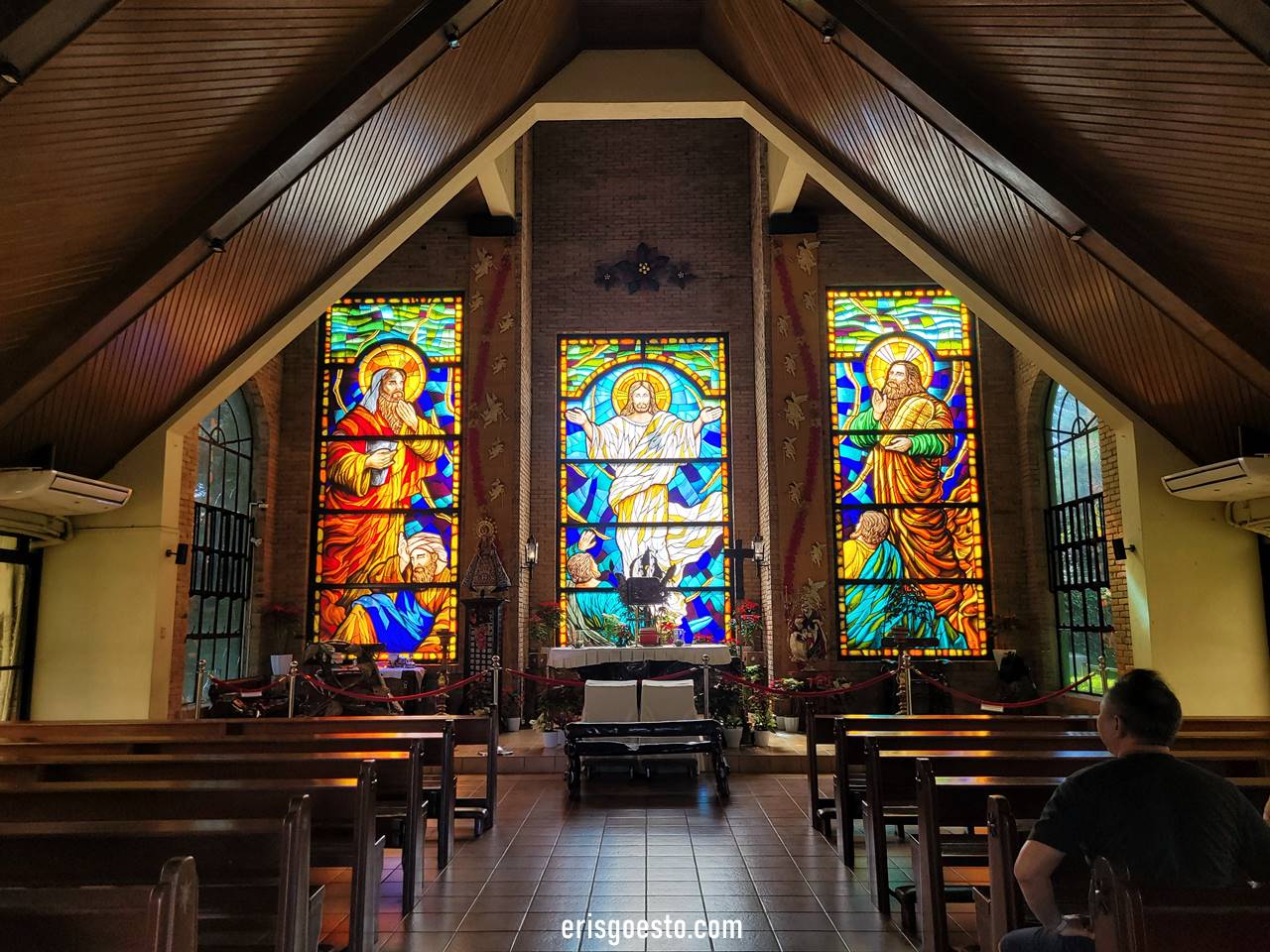
The interior of the chapel is hut-shaped, with sloping roofs and low windows that allow for natural lighting. The wooden benches and pews are polished to a smooth shine. Behind the altar are three striking stained glass windows that depict the Transfiguration of Jesus, a canonical event in the Bible whereby Jesus’ appearance was changed into his glorified form, with his robes turning a dazzling white. Depicted in the other panels are Jesus’ disciples Peter, John, and Luke, as well as Moses and Elijah.

A Nativity scene in the garden.
There were a couple of spots within Caleruega that we missed, such as the koi pond, the hanging bridge, and the open-air chapel, which has similar stained-glass scenes of the Transfiguration. If you’re coming to visit, allocate at least an hour or two to fully explore the church grounds!
Getting There
- Via South Super Hi-way: * Take Sta. Rosa Exit, proceed towards Tagaytay Market, turn right to Rotonda.
- Via Coastal Road: From Roxas Blvd. proceed to Aguinaldo Hi-Way all the way up to Tagaytay
- Public transport: Proceed to CROW Bus terminal along EDSA in Pasay. Board buses going to any of these destinations: Nasugbu, Balayan, or Calatagan. Get off at Ever Crest, Batulao, Nasugbu Batangas. Tricycle service is available at Evercrest entrance or hike through a two kilometre road to Caleruega.
CALERUEGA CHURCH
Bgry. Caylaway, Batulao, 4231 Calleruega Rd, Nasugbu, Batangas, Philippines
Open: 6AM – 5.30PM. Sunday mass at 11AM.
PS: If you enjoyed reading this, please consider supporting my website via Patreon. This will go towards hosting fees and ensuring that I can continue to deliver authentic content for your reading pleasure. Or buy me a cup of coffee at paypal.com @erisgoesto. Thanks for stopping by!


Leave a Reply to LookoomCancel reply