A public institution of higher learning seems like an unlikely tourist place, but I was pleasantly surprised to find that there was lots to see at the University of the Philippines, Diliman. It is a constituent of the original UP Manila and spans some 400+ hectares of land. It’s so massive that students (and members of the public, since parts of the campus are open access) have to take a localized Jeepney, or ‘ikot’, around campus.
Consistently ranked as the best university in the Philippines, UP as a whole has churned out over 260,000 (living) alumni since its establishment in 1908. It has 7 major campuses nationwide, including in Cebu, Baguiao, Visayas and Mindanao. The Diliman branch is the seat of administration, as well as being the largest campus.

One of the most well known landmarks within the grounds is the General Antonio Luna Parade Grounds, or the Sunken Garden. Located on the uni’s east side, it is so named due to its natural basin-like depression. The lush green field is rife with activity in the evening, with students playing sports and joggers making their rounds. Every year, the field hosts the UP Fair and sports tournaments.

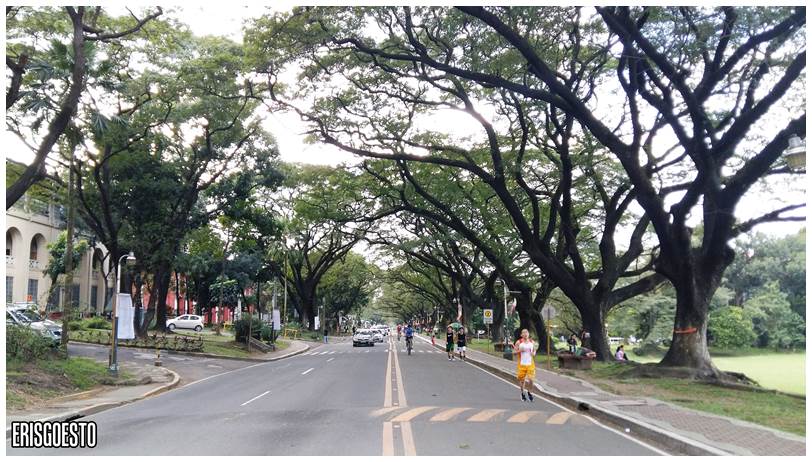
Next to the Garden is a long avenue lined with shady, ancient-looking trees which provide shelter from the hot sun. The roads are wide and well kept, making it great for joggers and cyclists. The cool, serene surroundings is a far cry from the crazy, polluted saga that is downtown Manila. I wouldn’t mind studying here! 😉

Academic buildings to the left.

Nearby is a statue of Andres Bonifacio, a national hero known as the ‘Father of the Philippine revolution’. He was the leader of the Katipunan, a movement calling for independence from Spanish Colonial rule. Bonifacio Day is celebrated on November 30.

At the end of the 800m long Commonwealth Avenue is the Oblation statue, an iconic figure in the UP system. Originally, the figure was naked, but a fig leaf was added later on to cover it’s manly bits. During my visit, there was an art exhibition of some kind, with the statue encased within a large seashell.


Made from concrete by Filipino artist Guillermo E. Tolentino, the sculpture shows a man facing upward with his arms outstretched, which symbolizes selfless offering to one’s country.The statue was inspired by the second verse of Jose Rizal’s Mi Ultimo Adios (My Final Farewell), in which Rizal describes:
In fields of battle, deliriously fighting,
Others give you their lives, without doubt, without regret;
Where there’s cypress, laurel or lily,
On a plank or open field, in combat or cruel martyrdom,
If the home or country asks, it’s all the same–it matters not.
I think the statue captures the essence of nationalistic pride and love for one’s country, don’t you?

Behind the Oblation is the Quezon Hall, overlooking another field.

Want something different from the usual touristy spots in Manila? Pay UP a visit! 🙂 It’s also super close to my favourite spot in Manila, Maginhawa (where there are loads of hipster cafes!) so it’s just a short taxi ride away.



Leave a Reply