It’s easy to tell the time accurately these days, thanks to our smart devices and the internet. If we’re lost, there’s always the GPS.
In the old days, though, telling time and direction meant relying on objects in the sky. Most people would look at the sun and it’s shadows to estimate the time of day, or the stars at night to determine direction.
Sawai Jai Singh, however, was not most people.

The 17th century Rajput ruler and founder of Jaipur city wanted the capital to align with the stars, in accordance with the Hindu principles of Vashtu Shrasta.
At the time, the Zij (an Islamic astronomical book) was the gold standard for astronomical calculations of the sun, the moon, and the stars, but the king noticed discrepancies between the readings on the instruments used and the book’s tabulations. He decided that in order to get more accurate readings, he’d need bigger instruments.
And when I say big, I mean big. Like largest-sundial-in-world level big.

And that’s how we come to have the Jantar Mantar in Jaipur, a UNESCO World Heritage Site comprising 19 giant astronomical instruments used to tell the time, measure the meridian, determine the position of stars and planets, predict eclipses, and more.
Derived from Sanskrit to mean “calculating instrument”, there are actually five Jantar Mantars in Northern India, all built by Sawai Jai Singh – although the Jaipur observatory is the largest and most well preserved.

The complex feels oddly austere and otherworldly, especially after our visits to the nearby City Palace and Hawa Mahal. My initial thought was that it looked like a giant geometry kit – the kind that students use in math / geometry class. In a way they are, just on a much larger scale, which makes the complex all the more fascinating.
What to see at Jantar Mantar, Jaipur

Here is the aforementioned world’s largest sundial! Dubbed the Brihat Samrat Yantra, it stands 27 metres (88 feet) tall, with a tiny observatory deck at the top so astronomers could look down on the semi-circular ‘wings’ on each side to tell the time.

You’ll also find a smaller sundial called the Nadivalaya Yantra (Equatorial Sundial). The instrument has two faces, one representing the northern hemisphere and the other, the south. It is designed in such a way that the sun’s rays will illuminate both faces only when it crosses the celestial equator ie equinoxes. On other days only one face is lit up. Pretty amazing, no?

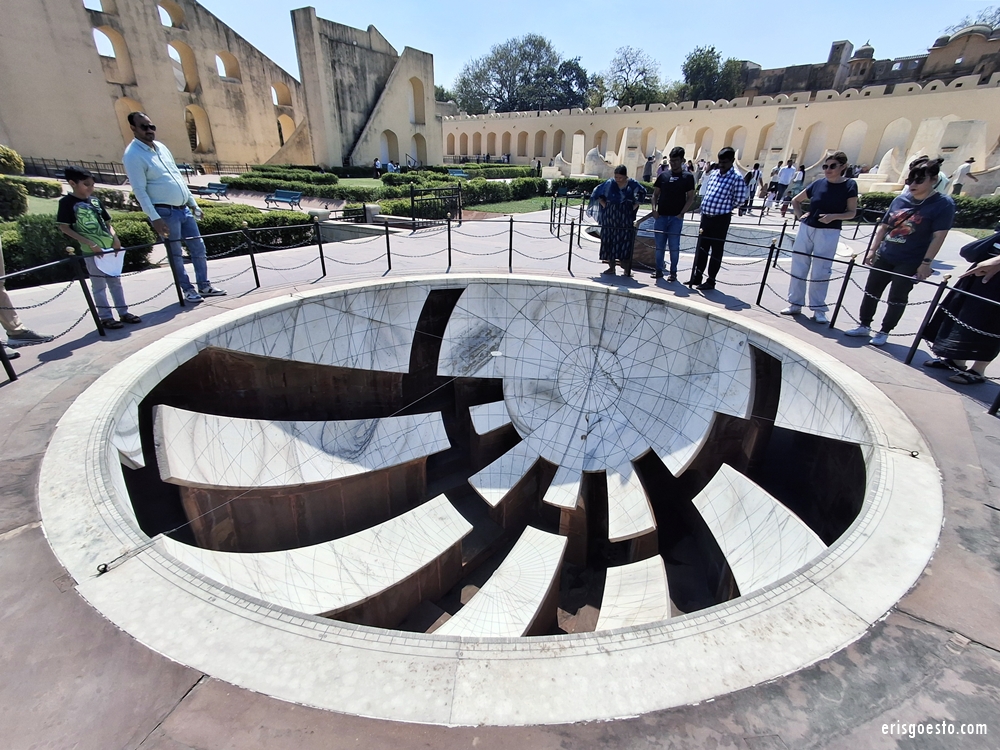
Almost in the centre of the complex are two large hemispherical bowls (Jai Prakash Yanta) with marble slabs jutting out from the sides forming an intricate geometric pattern. These are also sundials, and are designed to allow the observer to move inside the instrument (hence the hollowed parts).

More sundials. This one is called the Laghu Samrat Yantra, inclined at 27 degrees. This is apparently less accurate at telling the time. The colour of this sundial is closer to the Mughal colour scheme (red sandstone) and different from the rest of the structures, which are mainly yellow.

Taking a break from the sundials, we have the Unnatamsa Yantra, which features a metal ring divided into four segments, used to measure the altitude of celestial bodies.

Aside from the largest sundial, Jaipur’s Jantar Mantar also has one of the world’s largest astrolabes, measuring 2.43 metres. Astrolabes are sophisticated instruments that can accurately pinpoint planetary positions, an important part of Hindu astrology and cosmology – so much so that its name Yantra Raj Yantra, translates to “King of Instruments”.

After the opulent palaces and grand forts of Jaipur, Jantar Mantar was certainly a unique experience – showcasing that the Rajput empire was not only powerful and wealthy, but also way ahead of its time in terms of science, technology, and its understanding of the cosmos.
The giant instruments are a marvel to behold – although, owing to the open nature of the complex (it has to be this way since they’re using the sun for measurements) it can get pretty hot if you’re here in the afternoon. Bring lots of sunscreen, a hat, and water.
Tickets to Jantar Mantar
Tickets are priced at RS50 for locals and RS200 for foreigners. They can be purchased on-site or online here.
Opening hours: 9AM – 7PM (Last entry 6.30pm)
Getting There
The attraction is centrally located and easily accessible via auto rickshaw, bus, and taxi. The closest metro is Badi Chaupar (pink line), a 10-minute walk away.
**This post contains affiliate links from Klook.
PS: If you enjoyed reading this, please consider supporting my website via Patreon. This will go towards hosting fees and ensuring that I can continue to deliver content for your reading pleasure. Or buy me a cup of coffee at paypal.com @erisgoesto. Thanks for stopping by!




Leave a Reply